Frank was born in Czechoslovakia, near the Hungarian border. His early childhood was shaped by family, community, and the ordinary rhythms of life. But in 1938, everything changed. Following the Munich Agreement, his hometown was ceded to Hungary, and anti-Jewish laws quickly began to take hold. By 1944, when the German army marched into Hungary, Frank’s world had been torn apart. Everything his family had built was taken from them, and family members were deported to different camps.
Full episode · 9 min 34 sec
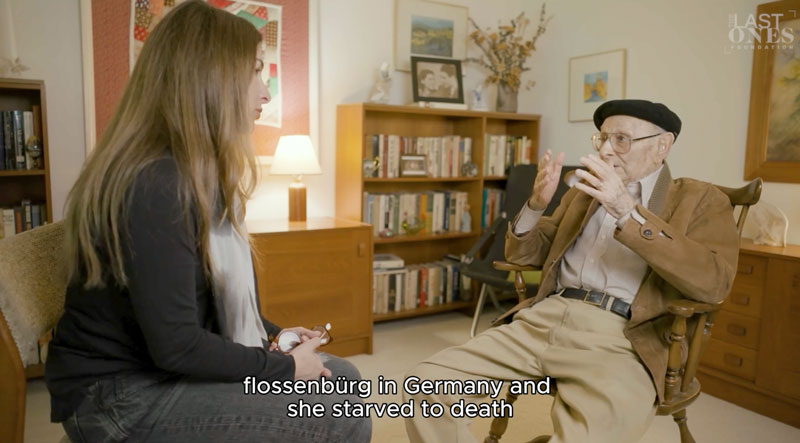
Frank recalls the devastating losses his family suffered. His half-brother was taken to a Nazi concentration camp and barely survived. His sister and her baby never returned. His mother was taken to Flossenbürg concentration camp in Germany, where she starved to death. Frank himself was forced into a Nazi slave labor camp in the rugged Carpathian Mountains of Transylvania, where prisoners were packed into crowded spaces and made to perform brutal labor. He was assigned to shovel heavy clay from boxcars while building a railroad track, work he believes could have killed him quickly.
What helped save him was a seemingly small piece of knowledge from childhood: he knew how to handle horses. As a boy, Frank had cared for his own pony. When a Hungarian officer needed someone to look after his horses, Frank became the groom. That role gave him brief contact with villages outside the camp, where sympathetic people sometimes offered him extra food or old clothing. In a world where survival often depended on a fragile combination of luck, instinct, and usefulness, this skill helped keep him alive.
In October 1944, during the chaos of a death march and Soviet bombardment in the area, Frank saw an opportunity to escape. He hid in cornfields and eventually made his way to Budapest. There, he joined an underground resistance network dedicated to saving Jewish lives. Working under the protection of the International Red Cross, Frank’s mission was to deliver false papers to Jews in hiding. Many Christian families were sheltering Jewish people, but doing so was extremely dangerous. False documents could mean the difference between life and death.
Frank reflects that luck and resourcefulness were two of the main reasons he survived. His ability to speak multiple languages helped him move through dangerous situations, communicate, and adapt. His knowledge of horses, his quick thinking, and repeated moments of chance all played a role. Again and again, survival came down to being ready when an opening appeared.
After the war, Frank’s mission did not end. He worked as a correspondent for a Russian general and later became a journalist in Prague. Back home, he was reunited with his father and helped shelter displaced Jewish people. He also became involved in helping people escape from communist Czechoslovakia, working in connection with efforts to move people toward safety and a new future.
An Interview with a Holocaust Survivor
Narration: Today I’m in Williamsburg, Virginia, visiting Frank, a 100-year-old Holocaust survivor, author, and former journalist. Frank was born in Czechoslovakia near the Hungarian border.
Frank: It’s my grandma’s recipe.Narration: In 1938, everything changed. Following the Munich Agreement, Frank’s hometown was ceded to Hungary, and anti-Jewish laws quickly took hold. In 1944, the German army marched into Hungary.
Frank: It was one of the changes.Narration: By 1944, his world was falling apart. Everything the family had built was taken from them. They were deported to different camps, including Frank, his mother, his sister, and her baby.
Narration: In October 1944, during a death march, chaos broke out as Soviet forces bombarded the area. Frank saw an opportunity. Hiding in cornfields, he escaped and made his way to Budapest. There, he joined an underground resistance network helping to save Jewish lives.
Narration: After the war, Frank’s mission was not over. He worked as a correspondent for a Russian general and later as a journalist in Prague. Back home, he was reunited with his father and helped shelter displaced Jewish people.
Frank: I became operative in Prague for the Mossad, for the Israeli Secret Service. I was helping people escape from communism.Narration: In 1954, shortly after his marriage, Frank and his wife escaped communist Czechoslovakia and started a new life in America.
Leslie: So did you come by boat? Frank: We came on the Queen Mary. And it was funny. A woman was waiting for us, and she put us into a taxi. The driver was from an Italian background, and he said, “I want to take you directly to Queens.” So he did. That was our introduction to America.We use cookies to improve your experience on our site. By using our site, you consent to cookies.
Manage your cookie preferences below:
Essential cookies enable basic functions and are necessary for the proper function of the website.
These cookies are needed for adding comments on this website.
Statistics cookies collect information anonymously. This information helps us understand how visitors use our website.
SourceBuster is used by WooCommerce for order attribution based on user source.
You can find more information in our Cookie Policy and Privacy Policy.
Have a question about The Last Ones? Send us a message.
We use the information you provide to respond to your message. Read our Privacy Policy.