
Yetta Kane was born on December 28, 1932, in a small Polish village in territory that is now Belarus. The youngest of three children, she remembers a traditional Jewish family whose livelihood came from farming. Her parents kept a horse, cow and chickens, and her mother sewed for neighbors. She describes a comfortable childhood and warm relations with the surrounding community before the war uprooted them.
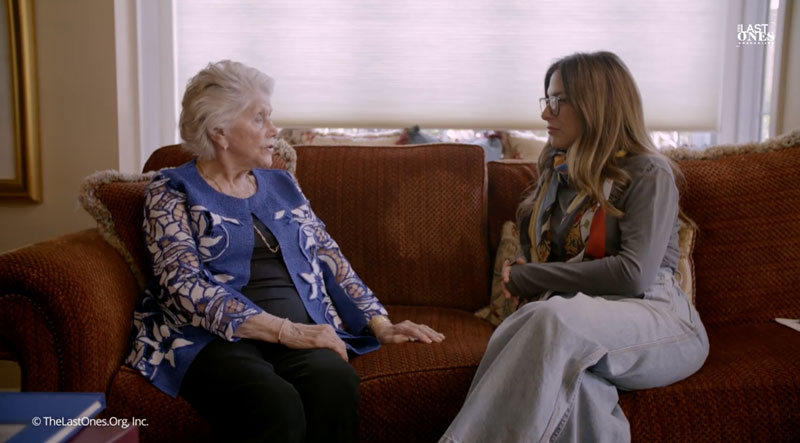
Full episode · 17 min 38 sec
Yetta Kane was born on December 28, 1932, in a small Polish village in territory that is now Belarus. The youngest of three children, she remembers a traditional Jewish family whose livelihood came from farming. Her parents kept a horse, cow and chickens, and her mother sewed for neighbors. She describes a comfortable childhood and warm relations with the surrounding community before the war uprooted them.
The episode places the family’s flight after Germany invaded Poland in September 1939; the precise village, date of flight, and intervening wartime chronology require verification. Yetta recalls spending nearly two and a half years in forests with her family among partisans. They slept outdoors, wore clothes and shoes until they disintegrated, wrapped their feet in rags, and lived with relentless cold and hunger. Her parents sheltered the children with their own bodies. One night, unable to cross a guarded railway, they hid silently in freezing water. Friendly villagers occasionally offered bread, milk or a barn; others threatened to denounce them. Her father, she recalls, took part in sabotage of German rail supply lines, while the family lived with the fear that he might not return.
The family eventually reached Sverdlovsk in the Soviet Union. Yetta recounts being offered possible destinations including Uzbekistan, Kyrgyzstan and Siberia. Her father chose Siberia, hoping the cold would protect them from disease. They lived in a dirt-floor room shared with a horse, sleeping on straw and struggling to obtain food. Her mother milked cows and tended pigs; Yetta remembers taking small amounts of food to survive. Despite hardship, she attended school and remembers not being targeted as Jewish there.
After the war, the family secured permission to leave and traveled by overcrowded cattle train toward Poland. Her mother sold hard-boiled eggs to help pay for tickets. During the journey her father was separated from the train while seeking food, but eventually found them again. Back in Poland, Yetta recalls renewed antisemitic threats, prompting the family to flee once more. She references the Kielce pogrom, though the transcript misdates and inaccurately describes it; this requires correction and contextualization before use. The family passed through Austria and Germany and lived in displaced-persons camps, where she continued her education.
Yetta arrived in Los Angeles on November 19, 1949. She describes the move as a rebirth. Although she had opportunities to study fashion design or languages, she went to work to support her parents. She later married and raised three children; at the time of the interview she describes six grandchildren and an expanding family of great- grandchildren. Speaking to students, she emphasizes kindness, compassion, helping people in need and teaching history so that hatred and persecution are not repeated.
An Interview with Yetta
Narration: Today I’m in Los Angeles to meet Yetta. She was born on December 28, 1932 in a small village in Poland, in what is now Belarus. She was the youngest of three children and grew up in a traditional Jewish family.
Leslie: Hi, Yetta. How are you?
Yetta: I’m okay.
Leslie: I’m Leslie. Very nice to meet you. I need to give you a hug.
Exchange: Oh, that’s mine. Thank you. You look amazing. Well, how are you? Did you draw something like this for me? For everybody. Yay.
Leslie: I brought you a little something. It’s a Lekach.
Yetta: Thank you. A good portion of life you gave us. [Unclear wording] heart. Thank you. I’m giving it to you.
Leslie: I baked it myself before I left Miami. Tell me where you want. I’m going to follow you.
Yetta: I’ve been watching lately a lot of videos.
Yetta: My parents were farmers. We had our own horse, a cow, chickens. We had everything we needed. We lived a very beautiful, comfortable life. We got along beautifully with our neighbors. We went to school. We got our education. And my mother used to sew for the neighbors and so on. So we had a very special relationship with all our neighbors.
Narration: In September 1939, Nazi Germany invaded Poland. As Jews were being rounded up in Yetta’s village, staying became too dangerous. Her family fled into the forest, where they joined the resistance.
Yetta: We were in the forest for a few years. Heaven was their blanket and the ground was their bed.
Leslie: How long did you stay in the forest?
Yetta: Almost 2 1/2 years. Every day was a new beginning, running, hungry, cold. The same rags we had on our bodies. We had no clothes to change. We had no shoes to change. When you outgrew your shoes, they fell apart. You were lucky if you could find newspapers or rags to wrap around your feet to protect us from the elements. Our parents, they kept us warm with their bodies. Whatever we had on our backs, it was falling apart.
Leslie: So you must have been cold all the time.
Yetta: Cold all the time. My parents kept us warm with their bodies. And we kept praying.
Yetta: Once we had to cross a railroad track, the Nazis, they had a soldier with a rifle, machine gun, whatever, and a German Shepherd, usually it was two of them. And we couldn’t cross, so we had to run back into the bushes. And the reason the dogs couldn’t smell through water, dogs cannot smell.
Yetta: Can you imagine sitting in bushes all night long your feet in water, your ankles were in the water, and when you looked down, you could see what looked like glass in front of your eyes. Can you imagine the water began to freeze and you had to sit like that? You couldn’t cry out because there would be so many other people that might die because of you.
Yetta: So we had to be quiet and bite into our clothes so we wouldn’t yell out. We had to do what we had to do to survive.
Yetta: We got whatever we were able to steal from the field. To live, to continue life, you had to do whatever you had to do. And when there were nice people to let us in and give us maybe some hot milk or let us take a bath in the bathhouse, that was a gift.
Yetta: Sometimes we walked for hours and hours to escape from the fighting. It was the grace of God we never got sick. Starving, cold, hungry, running, scared, afraid, we never got sick. Being farmers, we knew where to find some potatoes, where to dig out some vegetables or stuff so we wouldn’t die of starvation.
Yetta: And sometimes we’d come to a village and we’d ask if we could spend the night in the barn or maybe take a bath. But it was a double-edged sword. We had to have somebody stand watch. Sometimes the other neighbors were not so friendly towards the partisans and the Jews. They’d squeal on us. So we had to run half undressed to escape the slaughter.
Yetta: Through the kindness of some people, we got a piece of bread, a night in a barn, and maybe some hot milk. It was like manna from heaven. It was a blessing. And that’s how we survived.
Yetta: All those people, the Nazis, the Germans were robbing them, raping them, taking everything they could from them to feed themselves and to have food for their soldiers. They didn’t have much. They had to hide whatever they could before they came to take everything away from them.
Narration: Food was in short supply, and finding clean water was another daily struggle. Yetta’s health continued to get worse, although the real reason would only become clear much later.
Yetta: I had to drink water from puddles. I had parasites living within me from drinking water from puddles And from eating food that was not edible. After the war, I was given medicine to get rid of them. Whatever little I ate they ate, I looked sort of like a walking skeleton, a skinny, [word unclear in subtitles] little kid. It was very painful.
Yetta: How can you explain it to a child today or an adult? Some things are beyond explanation. And you cannot put it down with a pen. It’s just beyond. So those are things it’s too difficult to explain. And there’s a saying, you never know what a person goes through in life unless you walk in their shoes.
Narration: Yetta’s father helped sabotage Nazi supply lines, blowing up railroad tracks and loosening bolts to prevent German trains from reaching their destinations.
Yetta: Many times, when a partisan like my father never came back, the grenade might have exploded, or while he was running, he was shot by the Nazis.
Yetta: Once we were running, we came to a river, with a very, very strong current, I remember. And there were still parts of human bodies on the ground by the river where the Germans and the Russians had been fighting. Arms, legs, bodies. That was my growing up.
Leslie: You would see this as a kid?
Yetta: Yes.
Narration: After several years of resistance in the forest, Yetta and her parents somehow managed to reach the Soviet Union. But they now faced another difficult decision. Where could they go to find safety?
Yetta: We were in Sverdlovsk, and and they asked us to choose between three places we could go: Uzbekistan, Kyrgyzstan, or Siberia. My father was very scholarly, very learned, but he didn’t know much about the geography of the world. So he asked them, what’s in Uzbekistan and Kyrgyzstan, and what is Siberia like? And they told my father that those two places were very, very hot, while Siberia was very, very cold.
Yetta: And I could close my eyes and hear my father say to my mother, “If we go to those two places, we will die like dogs from the malaria, from malnutrition, from lack of sanitation and overcrowding. If we go to Siberia, the lice will freeze, the diseases will freeze, and maybe we will survive.” And he was right. Most of the people who went to those hot countries died because of all the things I have mentioned.
Yetta: In Siberia, we had a room with a dirt floor. and one small window. And it was as big as a small bedroom. We shared it with a horse. He helped keep us warm.
Yetta: There was a tiny little thing, like a small barbecue pit, and two-by-four boards. And we had straw for a mattress and hay for pillows. And some of the people felt sorry for us, but they didn’t have much to give us. They gave us something to cover ourselves with, and we lived like this for over a year.
Leslie: Again, same rags on your back?
Yetta: Yes.
Leslie: And you never were sick?
Yetta: Never. It was a miracle, too. My mother was milking cows and feeding pigs. She used to get up at two or three in the morning, so we’d have a little milk, because otherwise you’d be stealing from the government. They had to save the food to send to the soldiers to feed them. It was a crime. If they caught a man doing it, they’d send him to the front lines. He’d never come back.
Yetta: And then we’d steal some of the food before the pigs got it. We got a little bit too. That’s how we survived. Nobody was calling us names. Nobody was hurting us. They didn’t know who we were. We were just refugees, period.
Yetta: I went to school. I did not miss a day of school.
Exchange: Over there in Siberia? Siberia.
Yetta: I finished junior high school. Children used to get 400 grams of bread a day and working people 800 grams.
Yetta: We stayed there till 1945 when the war ended. Stalin at that time gave the amnesty that all the foreigners could return home.
Narration: Luckily, Yetta’s cousins were able to confirm that her family had originally come from Poland, allowing them to leave the Soviet Union. But there was one more obstacle. They needed money for train tickets, and somehow they had to find a way to pay for them.
Yetta: We had to raise money for tickets to go back to hell, to Poland. I don’t know how my mother ever got a hold of eggs. I would sell hard-boiled eggs. Then we were on a train, to go back to Poland.
Yetta: We were put on a cattle train, and they had two-by-fours on each side of the doors to get in, the sliding doors. There was no bathroom, no water, no Red Cross, nobody to help us. Again, it was survival of the fittest.
Yetta: So my father would go along the train. He found some Jewish soldiers who gave him some cigarettes. He’d take the cigarettes and barter, trying to get some food. And then once he went to try to get food for us, the train started moving. Something hit him in the knee and knocked him away. We didn’t know whether he lived or died. He didn’t know where we were. They were going one way; we were going another way. He finally found us.
Yetta: We were on the train for maybe over a month. It was a cattle train. There were two double bunks of boards. There were refugees escaping, going back. Again, no food, no sanitation, no bathroom.
Yetta: Can you imagine for a girl, 11, 12, to have your father hold you? The door was open a little bit. You had to use the bathroom. How can you explain the pain, the embarrassment, the humiliation? But we had no choice. But that made us stronger, made us believe in God even more.
Narration: After an exhausting journey, the family finally made it back to Poland. Around 4,500 Jews had returned from the Soviet Union, hoping to rebuild their lives. But Poland was no longer the country they remembered. Antisemitism was still very much alive.
Yetta: Then we were there. Then they tried to kill us too. My father said, “We have to leave because tomorrow might be too late.”
Yetta: We met some people on the way. At the end of the war in ’45, there was a pogrom in [place name unclear in subtitles], where about 40 or 50 Jewish people had survived hell, torture, hiding, surviving. And they came to reclaim their homes and their property. And the nice, wonderful people who had moved into their property did not want to give it back. They drowned them all in the river. So they told us, “Go wherever you can, but don’t stop at home.”
Narration: After years of hiding, fleeing, and moving across Europe through Austria and Germany, Yetta and her family ended up in DP camps, where she continued her education. Eventually, America seemed to be their only hope for a new beginning.
Yetta: When I came to Los Angeles in the United States, on November 19, 1949, we were actually reborn when this country let us come. and become citizens and grow. I was able to work and earn money.
Yetta: I was told I could go to school, get a degree in designing, clothes making, fashion designing, or I could go to school and become an international interpreter. I couldn’t do that because I had to help support the family. And my parents didn’t have any money to send me to school.
Yetta: So I went to work and I was earning $100 a week without knowing any English. $100 a week would buy as much as maybe $1,500 to $2,000 today. A carton of eggs was twelve cents, a carton of milk maybe fourteen cents, and a loaf of bread twenty-two cents. So it’s all relative.
Yetta: So I helped support the family. for almost two years, and was making good money. And then I met my late husband.
Narration: In 1950, Yetta’s future husband answered the call to serve in the Korean War. His service in the US military would later open the door to American citizenship. Yetta also contributed to the war effort, using her skills as a seamstress.
Leslie: So how many children do you have?
Yetta: Three wonderful children. six grandchildren By June 7, I should have twelve great-grandchildren.
Yetta: Money only pays bills and buys material things, but inner peace and love and compassion, understanding, there isn’t enough money in the world for that. And I’m blessed to have all that.
Leslie: You talk to kids very often, to schools. What is your message to them?
Yetta: I tell them to be kind, to be loving, to be inclusive, to be compassionate, to be caring, to be giving. And remember, you never know when you need help. Stretch out your hand. Help somebody in need. And if you need help, hopefully there will be somebody to help you too.
Leslie: When you see, Yetta, what’s going on around the world, this rise in anti-Semitism, how do you feel about it?
Yetta: To me, that is beyond what I can explain in words. I never thought in my lifetime that I would see such an upheaval, such ugliness, such dark corners in the world, in some people’s hearts. Unless we teach history and we talk about it, history, God forbid, could repeat itself again.
Yetta: I could talk for days without a stop. My CD is still working, but some things I cannot explain. And I only hope and pray that we could learn from the past so it doesn’t repeat itself, and that there will be peace for everybody.
Yetta: I’m just grateful for this country for giving me the opportunity to raise a wonderful family. And I hope and pray that I’m leaving a better place for them than what’s going on right now.
Leslie: Thank you so much for having me here today. It was really a pleasure to meet you.
Yetta: Likewise.
Leslie: And you’ve taught me so many life lessons. You know how you said that your students, sometimes they tell you that you’re an inspiration?
Yetta: Yes.
Leslie: I get it. You are.
Yetta: Thank you.
Leslie: Do you realize you are?
Yetta: I hope to try to pass on some of the things to people who will pass them on to future generations.
Closing exchange: Well, as we say… [Closing phrase unclear in subtitles.] Thank you so much. Bye.
We use cookies to improve your experience on our site. By using our site, you consent to cookies.
Manage your cookie preferences below:
Essential cookies enable basic functions and are necessary for the proper function of the website.
These cookies are needed for adding comments on this website.
Statistics cookies collect information anonymously. This information helps us understand how visitors use our website.
SourceBuster is used by WooCommerce for order attribution based on user source.
You can find more information in our Cookie Policy and Privacy Policy.
Have a question about The Last Ones? Send us a message.
We use the information you provide to respond to your message. Read our Privacy Policy.