
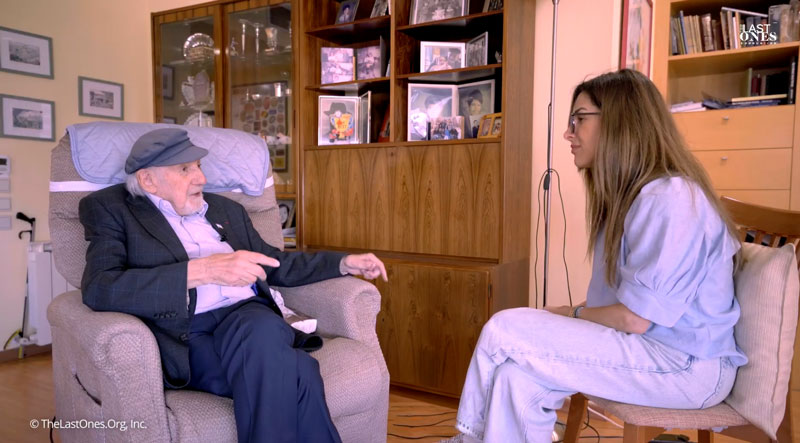
Walter Bingham escaped Nazi Germany on the Kindertransport, served as a British Army ambulance driver in Normandy, and later worked in counterintelligence. In Jerusalem, he tells Leslie why he continues to share his story with young people.
Full episode
Walter Bingham was born Wolfgang on January 5, 1924, in Karlsruhe, Germany, according to the episode narration. He remembers the transition from the Weimar Republic to Nazi rule with the sharpness of a child who experienced it in the classroom. Before January 30, 1933, he was one of the boys playing ball. After Hitler came to power, his classmates excluded him, and he was made to sit alone at the back. He recalls escalating abuse of Jewish pupils, the indoctrination of German youth, and the effort by Karlsruhe’s Jewish community to find a building and teachers so their children could continue learning.
Walter later studied in Mannheim and lived at a Jewish orphanage. On the morning of November 10, 1938, he walked toward the synagogue and witnessed the destruction associated with Kristallnacht. He remembers firefighters protecting adjacent buildings rather than extinguishing the synagogue fire. He also recalls the October 28 roundup of Polish Jews: when he contacted his mother about returning home, she told him that his father had been taken. Walter says he never saw his father again.
On July 25, 1939, Walter’s mother brought him to a train as he departed on the Kindertransport for Britain. He was about fifteen and a half. His testimony emphasizes the courage of parents who placed very young children on trains toward an unfamiliar country and the trauma of separation. The narration says he reached England safely and was sent to an agricultural community in Wales.
Walter joined the British Army on January 6, 1944. Trained initially in infantry, he became an ambulance driver and served during the Normandy campaign. In a vivid account of the fighting around Hill 112, he describes driving forward under German fire to evacuate wounded men after his first ambulance was disabled. He says he received a medal for bravery from the King. Following service in France, the Netherlands and Belgium, he trained in document work and counterintelligence. He was posted to Hamburg on May 8, 1945, where he examined Nazi records and recounts questioning former foreign minister Joachim von Ribbentrop, who denied knowledge of the Final Solution.
After years without news of his mother, Walter located her in a refugee camp in southern Sweden and arranged to meet in Copenhagen. The reunion was emotionally difficult; he describes finding food stored in layers on a windowsill at her camp, a lasting sign of deprivation and insecurity. The narrator says Walter later studied philosophy and politics, worked as a radio journalist, lived in England until 2004, and then moved to Israel. At the time of filming in Jerusalem, he was 102 and remained active as a journalist and radio host. Walter closes by explaining why survivors must speak directly to young people: testimony gives otherwise almost unbelievable history a human face, and education remains urgent.
An Interview with Walter
Narration: Today I’m in Jerusalem to meet Walter, a 102-year-old Holocaust survivor. He was named Vulgang at birth on January 5th, 1924 in Kausa, Germany. His extraordinary life has taken him across Europe from Germany to Poland and England. Over the years, he’s been an ambulance driver, a counter inelligence officer, a journalist, and so much more. And at 102, he’s still an active journalist, earning himself a place in the Guinness Book of World Records. Coming coming.
Leslie: Hello.
Walter: Hello.
Leslie: How are you, Walter?
Walter: Very good, thank you. Very good. What’s your name?
Leslie: I’m so glad to meet you. Leslie.
Walter: Leslie. Okay. Okay.
Leslie: I brought you a little something.
Walter: Oh, that is very nice. It’s a leaker. You need not a leaker. I do need to
Leslie: Can I ask you something?
Walter: Yeah.
Leslie: Did I Did I hear Well, that you are going to jump from a plane.
Walter: Well, I did it when I was 95 or six and I did it when I was 100 and I intend to do it again before the summer. Yes.
Leslie: And how old are you?
Walter: Uh right now, uh 102 and a half.
Leslie: And you are you are going to jump.
Walter: Yeah.
Leslie: But what got into you?
Walter: I don’t know. I’m a I’m a I’m a crazy guy. This is my studio. It is my radio studio. I had uh two radio shows a week. Now these are the two Guinness records for being the oldest journalist working journalist. Yes.
Leslie: Wow.
Walter: And and the oldest radio talk show. And as for the rest, there’s number of other things.
Walter: There were no Jewish schools in in the in my town in Korea. So, uh I went to a normal school, but I went there to school 3 years before Hitler came to power during the Bhimmer Republic. Anti-semitism, as we learned, existed all the time. Uh but there it was covert more or less. And uh at school I we played ball. I got the ball. I was one of the boys. And then came uh 30th of January 1933 and Hitler came to power and I was nine at that time. And then everything changed. Things changed fairly quickly because of course the teachers had their briefings how to teach national socialism and Nazism and of course the boys are boys in the class. The boys were the children of the their their parents who voted for Hitler. So you can imagine that they were indoctrinated from a young age from a young age by their parents. Everything changed. I didn’t get the ball anymore. I was ignored. So I had to sit in the back on my own.
Narration: Indoctrination began at an early age. And it didn’t stop when school ended. After classes, children would join sports clubs or paramilitary groups. They wore uniforms. They marched. They trained. Little by little, Nazi ideology became part of their everyday lives.
Walter: Children had to go to the Hitler Youth. There they were another segment, another part of their indoctrination that they were trained in exercising as soldiers. They were going to be the future soldiers. Hitler said, “Give me a boy until he is eight, and I’ll make him my man for life.” Paramililitary organizations had a ceremonial dagger. The Hitler Youth also had a dagger. On the blade of the dagger is engraved blue and error, blood and honor. The more blood you make with it, the more honor you have. And not any old blood, but Jewish blood. Why Jewish? Because in the evening when they were exercising, they were singing songs. And one of the songs says, “When Jewish blood spurts from the knife, everything goes much better.” If you know anything about being bullied at school, that that’s nothing what the Jewish children had to to bear. You were attacked and you were spitted and you were shouted and you were chased chased and it was very very tough for for for us at school. They were all thrown out of of their jobs. Yeah. So now I was out of school for a while and then the Jewish community in my town went to the school board and said, “Can you not find us a place where we could educate our children?” They send us to the most deapidated old school building in the city where they gave us to to be educated. But but half that building was occupied by children who needed remedial teaching. So we were in that building and now the the Jewish community had to find teachers when they gave us the building.
Narration: To continue his education, Walter’s parents sent him to a school in Manheim. It was there that he witnessed the night everything changed.
Walter: I was accommodated at the Jewish orphanage. And every morning I went to school to the school room which is behind the synagogue. And one day I walked to school and there was a bit you could see there was something in the air not not right. And as I got nearer and nearer I saw more and more people and that was Christ. the morning of the 10th of November and I got to the synagogue and and the people were standing around and I saw what happened to the synagogue and the fire service was there but not to douse the flames but to cool down neighboring properties and shouldn’t catch fire on the 28th of October. I was in Manheim. There were Polish shoes were rounded up. I wanted to come home. Contacted my mother and she said, “Stay where you are. They just took your father.” So I never saw him again.
Narration: L sent shock waves around the world. In response, organizations mobilized, urging foreign governments to open their doors to those fleeing Nazi persecution. Their efforts focused particularly on Great Britain. The goal was to save as many children as possible. This rescue operation became known as the Kinder Transport.
Walter: My mother took me to the train on the 25th of July 19 39. She took me to the train, decided to put me sent me away in a strange country. I I I learned a few words of English in the Jewish school, but nothing to speak about. I was 15 and just over 15 and a half or 15 and a half. So, I was one of the older ones, but then there were three and four year olds and younger ones. The parents were heroes. Absolute hero. Took them to the train and the children thought they were being punished. Mommy, mommy, daddy. And the parents outside and the children inside and you and the train went out went away. It was very very traumatic even for me. A and and 99.5% of the children never ever saw their parents again. They became all of them victims of uh of the Nazis.
Narration: After a long journey, all the children from that convoy arrived safely in England. Some were welcomed into foster homes, others by relatives or local communities. Walter was sent to an agricultural community in Wales, and when he was old enough, he enlisted in the British Army.
Walter: on the 6th of January 1944. That’s when I joined up the British army. And uh then I was uh trained in infantry, normal basic training and then I become an ambulance driver. I get a red cross ar. I’ll be safe. Big mistake. And I got where it was heavy battles in Normandy. a few days after after the D-Day and then I ended up in the battle of Hill 112 which was books written about it. The heaviest battle in Normandy. Whoever controlled Hill 112 controlled a very large part of I was forward of the infantry with my ambulance in a hole and next to me another hole with my medic and another hole with a doctor forward of the infant. They thought we were the furthest forward and suddenly somebody from from the further forward came running back and found us and said come and help us. We are being shot up by the Germans. It was an anti-tank unit and on the other side where were German Tiger tanks the whole anti-tank unit was decimated. they came. So I took my ambulance and I went forward and a heavy fire. Sometimes I had to dive under a personnel carrier that had about that much clearance. Mhm. But it was too heavy. And my ambulance medic, my medic, he was got he was also under there and he got shrapnel and he was out. Yeah. And I’m trying to load up the ambulance with a major in charge of the unit. The next thing I know, his head was here and his legs were over there finished. My ambulance was shot up, immobilized. I got out the fire and got back to the main dressing station. I took another ambulance that I they gave me and went back into the fire under heavy fire and there I evacuated managed to evac fill up and evacuate the wounded. So I got a big medal for bravery from the king.
Narration: After serving in France, the Netherlands and Belgium, Walter had other plans in mind. Fluent in both English and German, he wanted to join British counter intelligence.
Walter: I was trained, heavily trained as a document specialist and secondly in counter intelligence work. And on victory day, 8th of May, they sent me and another guy, they send us to Hamburg. And my job was supposed to be to go every Nazi office and have a look at the documents. We did the best we could and uh most of the documents we sent back to London.
Narration: A decision that would bring him face to face with some of the highest ranking figures in the Nazi hierarchy.
Walter: But the day before I arrived, they took over the uh building of the Gaung, which is the head of it, the whole Nazi hierarchy in the whole greater Hamburg area. And I had my own office. And one day they said to me, they Walter, you might want to speak to this Nazi we just caught, a high Nazi. Okay. Brought him in, sat him down. He was as a prisoner but he was not in any camp and he was your ribbon. I sat him down. He was a ambassador in England first and we spoke. What can you tell me about the final solution? That was my interest. I didn’t know anything about that. That was the furer. Now I thought myself, is she crazy? He’s the foreign minister of the of all occupied areas. She knew everything and he’s trying to tell me he knows nothing. I couldn’t get wild with him. Yeah. Couldn’t could have said you were a liar or something with But I could see there was no no point. not getting anything out of it. I had a camera, a contact which is like a Leica. When he saw the camera, he said, “Is this for publicity?” I’m telling you, he had delusions of grand publicity. He is a prisoner. At that point, I shouted at him, “Sit down. I’ll ask you a few more question then I sent him on.
Narration: Throughout those years, Walter had no news of his mother. Was she alive? Had she survived? He simply didn’t know. But her absence waited heavily on him.
Walter: Seven seven years of uh of of of development for the teenagers. Anyway, I found out she she had remembered or something addresses in in for her sisters in America and and we were searching and the search lists and this. Anyway, I we found each other and she was in southern Sweden in a camp and somehow we arranged she got permission to come to Copenhagen and I got army permission to go and we met in Copenhagen.
Walter: It was very traumatic. You can imagine I had to get to know her really. I went to the place where she was the refugee camp. I slept there. I came breakfast in the morning. So she said, see she take this upstairs. Bit of butter, bit of bread, bit of jam. Take it. Take it upstairs. Take it. No need, mama. No need. In the next meal, you’ll have exactly the same. They give. No, take it. And on the window sill was full of old food, a a piece of wood over it, a bread over it, another row five stories high full of old food.
Narration: After the war, Walter went to university, graduating in philosophy and politics, but for building a career as a radio journalist. He lived in England until 2004 when he moved to Israel. Today his family includes a daughter, two grandchildren, and two great grandchildren. And at 102, his extraordinary story continues.
Leslie: Walter, why do you share your story to speak to students to speak to young people?
Walter: Because if we wouldn’t do that all the survivors who are speaking, the people would not know. It’s quite different when a a person who has experienced it faces you and say this is what happened to me. I that’s what happened and that’s more believable. If somebody writes a a story of what happened in the Holocaust or all that that is so uh unusual, so out of the ordinary that it’s it’s it’s too much to believe. But when people like us go and tell their story what happens to us that has an impact and we have to educate the young people uh today. You see anti-semitism will never go. It has always existed. Anti-semitism is the panacea for all the ills of a nation. If they have economic ills, political problems and they need to take the mind of the population off the problem, then they turn to something very tried and tested and that is anti-semitism. So it’ll never go away.
Leslie: You send me some pictures when you do your jump.
Walter: Ah yeah. Well, you should send somebody to to maybe to come to come to film you to film the thing. There will be a lot of media there.
Leslie: That’s going to be great. Wonderful. I see you soon. Thank you so much. Thank you, Walter.
Walter: Thank you.
Leslie: Thank you. Bye.
Walter: Bye.
We use cookies to improve your experience on our site. By using our site, you consent to cookies.
Manage your cookie preferences below:
Essential cookies enable basic functions and are necessary for the proper function of the website.
These cookies are needed for adding comments on this website.
Statistics cookies collect information anonymously. This information helps us understand how visitors use our website.
SourceBuster is used by WooCommerce for order attribution based on user source.
You can find more information in our Cookie Policy and Privacy Policy.
Have a question about The Last Ones? Send us a message.
We use the information you provide to respond to your message. Read our Privacy Policy.